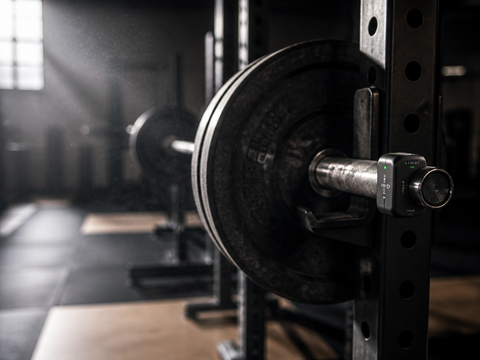
Here is a number a salesperson will hand you: 1,000 to 1,200 samples per second. That is the sampling rate printed on the spec sheets of most serious bar speed trackers — the small sensors you clip to a barbell to read velocity rep by rep. It sounds like precision. A thousand-plus snapshots of the bar's motion every second, in a lift that lasts maybe 800 milliseconds. Surely something that granular can tell you about power.
It can't. Not directly. And the gap between what that number measures and what the marketing implies it measures is the whole story.
We have used these devices on a platform, not just read the brochures. We have profiled athletes with them, cut sets short on them, and watched coaches mistake a tidy graph for an insight. What follows is the mechanical reality underneath the spec sheet, what bar speed trackers genuinely earn, and where the word "power" gets smuggled in without a receipt.
What the 1,200 Hz number actually measures
A sampling rate is how often the sensor records the position or acceleration of a point on the bar. That is all it is. High sampling rates matter because the concentric phase of a heavy squat or bench press is short and the velocity changes fast near the sticking point. Sample too slowly and you miss the peak. So 1,000 Hz is not marketing fluff — it is genuinely useful resolution.
But resolution of what? The device measures one thing well: linear velocity of the bar, in meters per second. Depending on the hardware, it gets there one of three ways. A linear position transducer (the tethered string-pull units like older GymAware setups) measures how fast its cable pays out, which is displacement over time. An inertial measurement unit — the little clip-on accelerometers and gyroscopes in most consumer units — measures acceleration, then integrates it to get velocity. An optical or camera system tracks a marker through space.
All three end up reporting velocity. None of them measures force. And without force, power is an inference, not a reading.
The walk from motion to "power," step by step
Follow the actual order of operations and you can see exactly where the honesty runs out.
First, the sensor captures motion — cable speed, or acceleration, or pixel displacement. Second, the software cleans and integrates or differentiates that signal to produce a velocity curve across the rep. This part is real and, on good hardware, accurate. Validation work on the linear-transducer GymAware and on the Tendo unit has put velocity error in the low centimeters-per-second range against criterion measures. Mean concentric velocity is the number you can trust most.
Third — and this is the move — the software needs force to give you power, because power is force times velocity. The device never measured force. So it back-calculates it. It takes the mass you typed in (the load on the bar), assumes Newton's second law, and uses the measured acceleration to estimate the force the bar experienced: roughly mass times (gravitational acceleration plus the bar's acceleration). Multiply that estimated force by the measured velocity and you get an estimated power.
Notice the assumptions stacked in that last sentence. The system assumes the entered mass is correct. It assumes the relevant mass is just the bar, not the bar plus the moving portion of your body — which in a squat is enormous and unaccounted for. It assumes clean acceleration data, which IMUs notoriously corrupt through integration drift. Each assumption is defensible in isolation. Stacked, they turn "power" into a modeled quantity wearing the costume of a measurement.
So when the app shows you 740 watts on that third rep, understand what it is: velocity you measured, multiplied by force you guessed, against a mass that ignores most of the moving system.
What velocity-based training genuinely earns
None of this means the tools are useless. It means the useful part is the part they actually measure — velocity — not the part they model.
The strongest case for bar velocity rests on a remarkably tight relationship. González-Badillo and Sánchez-Medina's work (notably their 2010 International Journal of Sports Medicine paper and the body of research that followed) established that for a given lifter on a given exercise, mean concentric velocity tracks load almost linearly, and that the velocity at a given percentage of one-rep max is highly stable. The headline finding people cite: the velocity at which a lift fails — the minimum velocity threshold — stays roughly constant for an individual even as their 1RM changes. That is what makes load-velocity profiling possible. You can estimate today's 1RM from a few submaximal lifts without grinding to failure.
That stability has real coaching value. It lets you autoregulate load to readiness instead of to a static percentage. It gives you a defensible velocity stop — end the set when bar speed drops, say, 20 percent below the first rep, and you cap fatigue and the mechanical breakdown that comes with it. Weakley and colleagues have published several studies through the late 2010s and early 2020s showing velocity feedback can acutely increase output and that velocity-loss cutoffs change the fatigue and adaptation profile of a session. Bryan Mann's velocity-based training work pushed much of this into practical American strength culture.
To be clear, this is the genuine article. The reliability of mean concentric velocity is well-established, replicated across labs and devices. If you buy one of these tools to autoregulate load and cap fatigue, you are buying something that works.
What it doesn't earn
It does not earn the word "power" in the sense an exercise scientist would defend, for the reasons above. The watt figure is a model output. Treat it as a relative trend on the same lifter, same setup, same device — never as an absolute, and never to compare two athletes or two days on different hardware.
It does not earn a claim of transfer to sport. This is the harder truth, and the one the marketing avoids. A faster bar in the gym is a measure of gym performance. Whether driving that number up makes a sprinter faster or a lineman more violent off the snap depends on the athlete, the demand, and a dozen training variables the sensor never sees. The data on velocity-based training improving sport outcomes, as opposed to weight-room outcomes, is thinner than the confidence with which it's usually sold. We are not aware of a body of replicated RCTs showing that chasing bar velocity beats well-run traditional programming for on-field results. Absence of evidence is not evidence of absence — but it is also not a sales license.
And the day-to-day individual reliability claims deserve scrutiny. Group-level velocity-load relationships are tight. The error band on a single athlete's single-session estimated 1RM is wider than a clean app screen suggests — often several percent, which on a heavy single is a real plate.
An honest rule of thumb
Match the tool to the job, and ignore the watts.
- If you coach barbell sport — powerlifting, weightlifting, general strength — buy a velocity tool to autoregulate load and set fatigue cutoffs, and use mean concentric velocity, the number it actually measures.
- If a device leads with peak power or force without a force plate or a tether, treat that figure as a relative trend, not a measurement.
- If your real question is "will this make my athletes better at their sport," no sensor answers it. Your programming and your eye do.
Here is the short table we wish came in the box:
| Number on the app | How it's obtained | How far to trust it |
|---|---|---|
| Mean concentric velocity | Measured directly | High — use it |
| Estimated 1RM | Velocity-load regression | Moderate — wide individual error |
| Peak/mean power (watts) | Modeled from assumed force | Low absolute, fair as same-setup trend |
| Force (without a plate) | Back-calculated from mass | Low — an inference, not a reading |
The verdict
Bar velocity as an autoregulation and fatigue-management signal: well-established. The minimum-velocity-threshold and load-velocity logic is replicated and usable.
"Power" and "force" off an inertial sensor as absolute measurements: plausible model, not a measurement — fine as a within-lifter trend, weak as anything else.
Bar speed driving sport performance: plausible but thin, and oversold relative to the evidence.
The sensor measures the bar. You still have to coach the athlete.