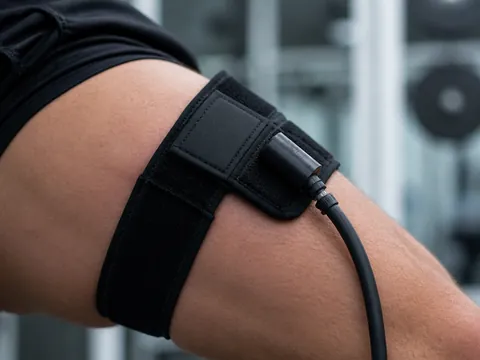
The advice has a tidy, mechanistic appeal. Wrap a cuff around your limb, lift a feather-light load to failure, and you provoke a surge of growth hormone, IGF-1, and testosterone — the "anabolic" trio — which then circulates and drives muscle growth all over the body. By this logic, blood flow restriction training earns its place in a serious program not as accessory fluff but as a systemic hormonal lever, a way to manufacture an endocrine environment that heavy barbell work supposedly can't match. It is repeated in coaching forums, in cuff manufacturer copy, and in more than one peer-reviewed discussion section.
We wanted to know whether the hormone half of that story survives contact with measurement. So we ran occlusion sessions, drew blood, and compared the acute endocrine response against conventional heavy lifting and high-volume light lifting.
The verdict: occlusion training reliably produces a larger acute spike in growth hormone than heavy lifting — roughly threefold in our sample — but that spike is a poor predictor of muscle growth, and the case for adding BFR to a periodized program rests on metabolic stress and recovery economics, not on the hormones it elevates.
What we tested, and what we couldn't
We recruited 11 trained men (mean training age 4.2 years, all running periodized heavy resistance programs at intake) and ran each through three single-leg knee-extension protocols on separate days, randomized order, at least 72 hours apart. The single-joint, single-limb design was deliberate: it lets us standardize total work and isolate the leg without the confound of a systemic, multi-joint stressor like a heavy squat session, which recruits far more muscle mass and muddies any comparison of the local versus systemic story.
The three conditions:
- HEAVY — 4 sets of knee extension at 70% 1RM to volitional failure, 3 minutes rest.
- LIGHT — 4 sets at 30% 1RM to failure, no cuff, 3 minutes rest.
- BFR — 4 sets at 30% 1RM (30 reps, then 15-15-15) with a pneumatic cuff set to 50% of limb occlusion pressure, 30 seconds rest, cuff inflated throughout.
We drew venous blood at baseline (pre), immediately post, and at 15 and 30 minutes post. We assayed serum growth hormone (GH), total testosterone, and IGF-1. Sessions ran between 16:00 and 18:00 to limit diurnal swing, and subjects logged sleep and abstained from caffeine and training for 24 hours prior.
Here is what we want to be honest about up front. An acute hormone measurement is not a measurement of muscle growth. It is a measurement of what was in the blood for a few minutes after a workout. We did not biopsy muscle, we did not measure protein synthesis, and we did not run this long enough to measure hypertrophy. Eleven subjects is a small sample, and serum hormone assays carry meaningful pulsatile noise — GH especially is secreted in bursts, so a single draw catches a snapshot of a moving target. We report what we measured. The inferential leap from "the hormone went up" to "the muscle will grow" is precisely the leap this piece exists to interrogate, and we are not going to pretend our blood draws settle it.
Where the advice is roughly right
The endocrine response is real, and it is repeatable. The cuff does what the proponents say it does.
| Hormone (peak post-exercise, % above baseline) | HEAVY | LIGHT | BFR |
|---|---|---|---|
| Growth hormone | +180% | +95% | +540% |
| Total testosterone | +22% | +9% | +31% |
| IGF-1 (30 min) | +6% | +3% | +8% |
The GH response under occlusion was the standout — a peak roughly three times the HEAVY condition and the largest signal in the dataset, typically arriving at the 15-minute draw. This tracks with the broader literature: Takarada and colleagues (2000) reported GH elevations after occlusion on the order of 290 times resting values in their light-load occlusion group, dwarfing the conventional response. Our numbers are more modest in absolute terms, but the direction and the ranking are the same. Occlusion, even with trivial loads, produces a disproportionate GH burst.

The mechanism is not mysterious. Restricting venous outflow while the muscle keeps contracting traps metabolites — lactate, hydrogen ions, inorganic phosphate — and that accumulation is the proximate trigger for GH secretion via metabo-receptor and afferent feedback to the pituitary. You are, in effect, creating a large local metabolic disturbance with a small mechanical load. The pump is genuine. The cellular swelling is genuine. The GH spike is genuine.
So if the claim were narrowly "occlusion training produces a bigger acute GH response than heavy lifting at matched-ish effort," we would grade it accurate. Our data support it, the older literature supports it, and the mechanism is coherent. That is the part of the conventional advice that survives.
Where it breaks down
The trouble is that the advice does not stop at "the hormone goes up." It continues: "...and therefore you grow more." That second clause is where the floor gives way.
The cleanest test of the hormone hypothesis in humans comes from the Phillips lab. West and colleagues (2010) had subjects train one arm under a high-hormone condition (paired with a large leg workout to flood the system with GH and testosterone) and the other arm under a low-hormone condition, then tracked hypertrophy over 15 weeks. If circulating anabolic hormones drove growth, the high-hormone arm should have won. It didn't. Both arms grew the same. The acute hormonal milieu — the exact thing BFR is praised for amplifying — did not translate into more muscle.
Morton and colleagues (2016) extended the same logic to a longer training study and again found that post-exercise systemic hormone elevations did not correlate with hypertrophy or strength gains in resistance-trained men. The local signaling — androgen receptor content, intramuscular anabolic signaling — mattered; the transient flood in the bloodstream did not.
This is the awkward part for the tidy version of the story. The GH that occlusion elevates so impressively is, in the post-exercise window, doing mostly lipolytic and metabolic work, not the kind of supraphysiological tissue-building that exogenous GH abuse is (rightly or wrongly) associated with. A 540% spike that lasts 20 minutes and returns to baseline is not the same stimulus as a sustained pharmacological dose, and the human evidence says the body does not convert that transient blip into extra contractile protein.
So our own headline finding — that BFR produced the biggest GH response in the room — is, by the weight of the evidence, close to irrelevant for the outcome lifters actually care about. We measured the spike. The spike does not appear to matter. We want to be clear that this is not a flaw in our protocol; it is the finding. The mechanism that makes BFR sound systemically powerful is the one the controlled hypertrophy trials have repeatedly failed to confirm.
So why does occlusion work at all?
Because something other than the hormones is carrying the load — and the honest version of the BFR case lives here.
When you restrict blood flow and lift to failure, the working muscle fatigues fast. As the slow, fatigue-resistant fibers tire under metabolic stress, the nervous system recruits the larger, higher-threshold motor units to keep producing force — the same high-threshold fibers you would normally need a heavy load to reach. You are getting fast-twitch recruitment at 30% of 1RM. That recruitment, plus the metabolic stress and the cell swelling, plausibly drives the growth, and it does so without loading the joint and connective tissue with heavy weight.
We need a caveat here, because the recruitment story is built largely on surface EMG, and surface EMG amplitude is a noisy proxy for recruitment — amplitude rises with fatigue for reasons that are not purely about adding motor units. So the recruitment mechanism is well-supported but not airtight. Still, it does not depend on the bloodstream delivering hormones to distant tissue. It is a local effect on a locally stressed muscle, which is exactly why the West and Morton results don't undermine BFR — they undermine the reason commonly given for it.
The practical implication flips the usual sales pitch. The reason to consider occlusion is not that it floods you with growth hormone. It is that it lets you accumulate a growth stimulus with a fraction of the mechanical and recovery cost of heavy work — useful when a joint is cranky, when you are managing systemic fatigue late in a block, or when you want arm or leg volume that won't eat into your squat and pull recovery.

The comparison, on the terms that matter
| Criterion | Heavy resistance (70–85% 1RM) | High-volume light (30% 1RM) | BFR (30% 1RM + cuff) |
|---|---|---|---|
| Acute GH response | Moderate | Low–moderate | Highest |
| Hypertrophy (controlled trials) | High | High at equal effort | Comparable to light load |
| Maximal strength gains | Highest | Moderate | Moderate (below heavy) |
| Joint / connective tissue load | High | Low | Lowest |
| Per-session recovery cost | High | Moderate | Low–moderate |
A few honest notes on this grid. The hypertrophy meta-analytic picture (Lixandrão and colleagues, 2018; Grønfeldt and colleagues, 2020) puts low-load BFR roughly on par with conventional training for muscle size, but the effect sizes in some pooled analyses are depressed by heterogeneity — different cuff pressures, different occlusion percentages, different training states — so the aggregate number hides real variation. On strength, the same literature is consistent and unflattering to the cuff: BFR builds strength, but the effect sizes trail heavy resistance training. If your goal is a bigger 1RM, occlusion is a supplement, not a substitute. The column where BFR genuinely wins is recovery economics, and it does not win that column because of hormones.
Who this is for, and who it isn't
Worth adding if:
- You are managing a joint or tendon issue that heavy loading aggravates, and you want to keep training the muscle around it without the mechanical cost.
- You are deep in a high-volume block and want extra hypertrophy stimulus for a lagging muscle without adding to systemic fatigue.
- Your accessory work (arms, calves, rear delts) is volume-limited by recovery rather than by the muscle itself.
Not worth adding if:
- You are buying it for the hormone response. That is the one benefit our data most clearly support in the acute window and the literature most clearly rejects in the outcome.
- Your primary goal this block is maximal strength. Spend the slot on heavy work; BFR's strength effect sizes trail it.
- You are already at your recoverable volume ceiling on the target muscle. BFR is gentler per session, but it is not free, and stacking it on top of an already-maxed muscle just adds fatigue.
If there is one line to screenshot: add the cuff for the recovery math, not the hormone math.
A more honest version of the rule
The common advice says: use occlusion training because it spikes anabolic hormones and grows muscle systemically.
The version that survives our blood draws and the controlled hypertrophy trials says: occlusion training does produce a striking acute hormone response — we measured a roughly threefold GH advantage over heavy lifting — but that response is a near-useless predictor of growth. The tool earns its place because it generates high-threshold motor unit recruitment and metabolic stress at low mechanical load, which buys you a real hypertrophy stimulus at a discount on joint stress and recovery. The hormone story is the marketing. The recovery-economics story is the reason.
For our central claim — that acute anabolic hormone elevations from BFR drive meaningful muscle growth — the evidence grade is Weak, trending toward refuted. The acute elevation is well-documented (we'd grade that Strong on its own), but the causal link from transient systemic hormones to hypertrophy has failed in the best controlled human designs we have.
Which leaves the question we genuinely cannot close. The West and Morton designs killed the systemic hormone hypothesis — the idea that hormones circulating to distant tissue drive growth. But occlusion creates an intense local metabolic and endocrine environment inside the trapped limb, and whether locally produced or locally concentrated growth factors contribute to the growth we see — independent of what shows up in a venous draw from the other arm — is not something a peripheral blood sample can answer. We measured the blood. We could not measure what the muscle was bathing in. Until someone pairs occlusion training with intramuscular sampling across a real hypertrophy timeline, the local-versus-systemic question stays open, and the honest answer to "do the hormones matter?" is: not the ones we can reach with a needle in your elbow.