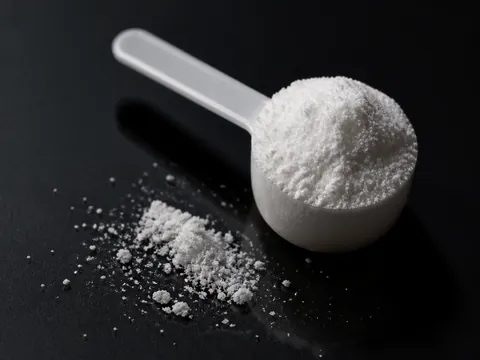
If you have spent any time in fitness forums, you have probably met the rule: if male-pattern baldness runs in your family, leave creatine on the shelf. It is repeated with enough confidence that a cheap, well-studied supplement gets quietly abandoned by people who would otherwise benefit from it. The concern is reasonable — hair loss is visible, hard to reverse, and nobody wants to trade a slightly better deadlift for a receding hairline.
So we went looking for what actually supports the claim. The short version: the evidence that creatine supplementation causes hair loss rests on a single 2009 study that never measured hair, and the proposed mechanism falls apart on closer inspection. The advice to avoid creatine for your hairline is, at best, an overreading of one weak signal.
That does not mean the question is silly. It means the answer deserves to be built carefully, because "trust me, it's fine" is exactly the kind of reassurance that should make you skeptical.
Where the rule came from
The entire myth traces to one paper: van der Merwe and colleagues, 2009, published in the Clinical Journal of Sport Medicine. The researchers took college-aged male rugby players and, in a crossover design, had them take creatine (a loading dose followed by maintenance) or a placebo, then measured circulating hormones.
The headline result: during the creatine phase, dihydrotestosterone (DHT) rose by about 56% after the loading week and remained roughly 40% above baseline through maintenance. The ratio of DHT to testosterone also climbed.
This is the load-bearing fact for the whole myth. DHT is the androgen most implicated in androgenic alopecia — the patterned thinning that affects a majority of men by their fifties. The logic writes itself: creatine raises DHT, DHT drives balding, therefore creatine accelerates balding.
The logic is clean. The trouble is in every link of the chain.
Level one: the study itself is thin
Before we touch biology, look at what the study can and cannot support.
- Sample size. The analysis ran on a small group of athletes — small enough that a single unusual responder can swing a percentage. A 56% jump sounds dramatic until you remember it is a percentage change off a low baseline in a handful of people.
- It never measured hair. This is the part most people repeating the claim never mention. The study measured a hormone in the blood. It did not measure hair density, hair shedding, follicle miniaturization, or anything you could see in a mirror. The leap from "DHT went up" to "you will lose hair" is an inference the authors did not test.
- Baseline imbalance. The creatine group started with somewhat lower DHT than the placebo phase comparison, which means part of that "increase" is the group rising toward a normal range rather than blowing past it.
- No replication. In the years since, multiple studies measuring testosterone and related androgens during creatine supplementation have not reproduced a meaningful DHT spike. A finding nobody can repeat is a finding you hold loosely.
To be fair to the original authors, the DHT increase reached statistical significance. We are not claiming the number was invented. We are claiming that statistical significance in one small sample, with no hair outcome and no replication, is a weak foundation for a behavior change you will worry about for years.
Level two: even if DHT rose, the mechanism doesn't follow
Suppose you grant the 40% number entirely. Here is the question that matters and almost nobody asks: does serum DHT — the DHT floating in your bloodstream — actually drive what happens at the hair follicle?
This is where the popular version of the story quietly assumes something false. Androgenic alopecia is not primarily a function of how much DHT is circulating in your blood. It is largely a local process. The enzyme 5-alpha-reductase converts testosterone to DHT right at the scalp, and the follicles in genetically susceptible regions are unusually sensitive to it. Two men with identical blood DHT can have completely different scalps — one thinning, one not — because the difference lives in local enzyme activity and follicle receptor sensitivity, not in the serum number.
So, let's run the implied logic in reverse. The drugs that treat hair loss — finasteride and dutasteride — work by inhibiting 5-alpha-reductase, which lowers DHT. So if cutting DHT slows balding, raising it must speed balding, right? Not necessarily. Those drugs suppress DHT dramatically and systemically and locally, far beyond anything a modest serum shift would do, and they act on the conversion step at the follicle itself. A small bump in circulating DHT is simply not the same lever.
Long story short: the myth treats a blood measurement as if it were a scalp measurement. They are not interchangeable.
What the direct evidence shows
The honest move is to test the actual claim — does creatine change hair — rather than argue about a proxy. Here is how the available evidence stacks up against the claim.
| Line of evidence | What it measured | What it found |
|---|---|---|
| van der Merwe 2009 | Serum DHT in rugby players | ~40–56% rise; no hair data |
| Follow-up androgen studies | Testosterone / androgens during loading | No consistent meaningful DHT change |
| Mechanistic literature on AGA | Drivers of patterned hair loss | Local 5-AR activity and receptor sensitivity dominate, not serum DHT |
| Recent controlled work tracking hair | Hair density / shedding during supplementation | No detectable increase in hair loss versus placebo |
The pattern is consistent. The one study people cite measured a hormone and stopped. Work that has gone further — either failing to reproduce the DHT change, or measuring hair directly — has not found the effect the myth predicts.
We will flag the limit here plainly: the body of work measuring hair outcomes during creatine use is still smaller than we would like, and follow-up periods are short. Nobody has run a multi-year trial tracking scalp density in genetically high-risk men. The absence of an effect in shorter studies is reassuring, not airtight.
Who should worry, and who shouldn't
If you are a recreational lifter taking 3–5 g of creatine monohydrate a day: there is no credible evidence this is doing anything to your hair. The mechanism doesn't support it and the direct data doesn't show it.
If you are already on finasteride or seeing a dermatologist for thinning: keep doing that, and don't credit or blame creatine for what your prescribed treatment is managing. Creatine is not interacting with your hairline in a way worth tracking.
If you are looking for a reason your hairline is receding: genetics, age, and local follicle sensitivity explain the overwhelming majority of patterned loss. A scoop of creatine is the least likely suspect in the lineup.
The honest version of the rule
The forum rule says: "If you're prone to balding, avoid creatine." A more accurate rule is shorter and less ominous — creatine supplementation has not been shown to cause or accelerate hair loss, and the one study suggesting otherwise measured the wrong thing. If you are predisposed to balding, the things worth your attention are the dermatology-grade ones: 5-alpha-reductase inhibitors, minoxidil, and an honest look at your family history.
What this piece did not settle: we cannot point to a large, long-term trial that tracked scalp hair density in high-genetic-risk men over years on creatine, because as far as we can find, one doesn't exist yet. If that study runs and finds an effect, we will say so. Until then, the place to look next is not another creatine forum thread — it's a dermatologist who can measure what's actually happening on your scalp rather than guess from a supplement label.
Evidence grade for the claim "creatine causes hair loss": Weak. One unreplicated proxy measurement, an implausible mechanism, and direct hair-outcome data that doesn't support it.