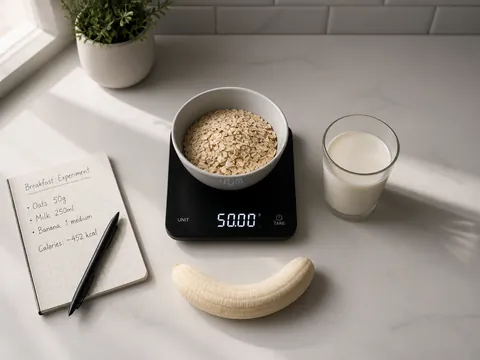
A few months ago one of us ran a deliberately boring experiment. Same kitchen scale, same breakfast — 80g of oats, 250g of whole milk, one weighed banana — eaten at the same time for fourteen mornings, with body weight logged on a calibrated scale immediately after the first urination of the day. The point was not to lose weight. The point was to stare at the numbers until the central question of energy balance stopped sounding like a slogan and started sounding like a physical claim that could be true or false.
It did not reconcile the way the bumper-sticker version promised. The breakfast weighed roughly 470g. Body weight wandered up and down by 600 to 900g between mornings while the food intake barely moved. If "calories in, calories out" were a simple ledger of grams on the scale, that ledger was a disaster. Which is exactly the frustration a thoughtful skeptic brings to the table: a calorie is a unit of heat — specifically the heat to raise a kilogram of water one degree Celsius — and nobody can explain why a heat unit should govern the mass of your body. The objection is good. The answer is better, and it lives in cellular chemistry, not in motivational posters.
The verdict, stated plainly: energy balance is correct, but the calorie is a downstream proxy. What actually obeys the books is mass, governed by conservation of matter and the roughly 40% efficiency of ATP metabolism. Heat is the inevitable receipt for that inefficiency. The rest of this piece traces a gram of food through the body to show why.
How we are going to account for it
We are going to ignore calories for most of this article and track mass instead, because mass is concrete and obeys a law no marketing department can repeal: it does not vanish. Every gram you eat does exactly one of four things.
- It gets absorbed or it doesn't.
- Once absorbed, it gets stored.
- Or it gets used — broken down to power the cell.
- Or it gets excreted.
That is the whole accounting frame. Atoms in, atoms out, with a buffer in the middle. If we can follow the carbon, hydrogen, oxygen, and nitrogen atoms of a macronutrient from the mouth to their exit, and if the books close, then we will have earned the right to ask where energy and heat come into it. We will not start with heat. We will arrive at it.
A note on what this method can and can't do. It is excellent for explaining why energy balance is mechanistically forced. It is poor for predicting the exact weight on a given Tuesday morning, because the storage buffer — especially the water bound to glycogen and the mass sitting in your gut — sloshes by hundreds of grams independent of fat gain or loss. That sloshing is what wrecked the fourteen-morning experiment, and it is the first thing the mass frame explains.
Storing stuff
Carbohydrate gets absorbed as glucose. Your body does not let glucose float freely in any quantity — at any moment your entire bloodstream holds only about 4 to 5g of it, roughly a teaspoon. The surplus goes into glycogen, a branched chain of glucose units. Your liver holds about 100g of glycogen; your skeletal muscle holds another 300 to 600g depending on how trained and how large you are.
Here is the part that ruins naive scale-watching. Glycogen is hydrophilic — each gram stored drags roughly 3 to 4g of water into storage with it (Olsson & Saltin, 1970, measured this in muscle biopsy work that has held up). Fill a depleted 500g glycogen tank and you can pull 1.5 to 2kg of water along for the ride. Burn it off over a low-carb weekend and the same mass leaves. None of that is fat. All of it shows up on the scale. A skeptic who has watched their weight drop 2kg in three days "from cutting carbs" is not imagining it, and is also not losing what they think they are losing.
When glycogen tanks are full and glucose keeps arriving, the body can convert the excess to fat through de novo lipogenesis — building fatty acids from scratch. In humans on mixed diets this pathway is quantitatively minor (Hellerstein, 1999); most dietary fat that ends up stored as body fat was already fat when you ate it and is simply re-esterified into adipose tissue. Either way, the storage destination for chronic surplus is the same: triglyceride in fat cells, which is where long-term mass actually accumulates.
Protein is the odd one. There is no dedicated protein storage depot the way there is for carbohydrate and fat. Amino acids beyond what's needed for building and repair get their nitrogen stripped off and the carbon skeleton is either burned or converted toward glucose or fat. Hold that thought about the nitrogen — it has to leave the building, and how it leaves matters.
Using stuff

Now the storage buffer is full and the cell needs to do work — contract a muscle, pump an ion, synthesize a protein. It does not spend glucose or fat directly. It spends ATP, adenosine triphosphate, the cell's actual energy currency. Glucose and fat are the fuel you put in the tank; ATP is the spark that fires the engine. The cell breaks down fuel to regenerate ATP from ADP, then spends the ATP, then regenerates it again, millions of times a second across trillions of cells.
This is where the calorie finally has to show up, so let's be precise about why. The chemical bonds in glucose, fat, and protein hold energy. Breaking them releases it. The cell captures part of that released energy in the form of fresh ATP bonds — and part is the operative word, because the capture is not perfect. Across the full oxidation of glucose, the cell traps roughly 40% of the available chemical energy as ATP. The other ~60% is released as heat, immediately, with no choice in the matter (Rolfe & Brown, 1997, reviewed the bioenergetics of this and the cellular efficiency figures cluster in this range across substrates).
That efficiency loss is not a flaw you can train away. It is thermodynamics. The second law guarantees that any energy transfer scatters some fraction as heat, and biological energy transfer is a long chain of such steps. Every macronutrient runs through the same final machinery — the electron transport chain — so the efficiency is broadly similar whether the fuel arrived as a bagel or a ribeye. Roughly 40% becomes usable ATP; the remainder warms you up. This is, quite literally, why you are 37°C and a rock is room temperature.
So the heat is not metaphorical and it is not optional. It is the receipt that prints automatically every time a chemical bond's energy is moved from fuel into ATP. Burn more fuel, print more heat. The correlation between energy expenditure and heat output isn't a convention chosen by nutritionists in 1890 — it's a physical consequence of how cells work.
Getting rid of stuff
Now the surprising part, the one that resolves the original puzzle. When you "burn fat," where does the mass go?
Not into the toilet, mostly. Not into sweat. The dominant exit is your lungs. When a triglyceride is fully oxidized, its carbon atoms leave as carbon dioxide and its hydrogen atoms leave as water. Meerman and Brown (2014) did the stoichiometry on this and found that of the mass lost when 10kg of fat is oxidized, about 8.4kg leaves as CO₂ exhaled through the lungs and the remaining 1.6kg leaves as metabolic water (urine, sweat, breath vapor). You exhale your fat. The scale goes down because carbon is physically leaving your body on every breath, bonded to oxygen you inhaled.
This is the moment the mass ledger snaps shut. Carbon comes in as food. Some is stored as fat. When that fat is oxidized to regenerate ATP, the carbon leaves as CO₂ and the hydrogen as water — and the energy released in severing those carbon-hydrogen and carbon-carbon bonds is the same energy, 40% captured as ATP and 60% radiated as heat. The mass leaving and the heat leaving are two ledgers recording the same event.
The nitrogen from protein leaves separately. The body converts ammonia — toxic — into urea through the urea cycle (the second word in that cycle's waste product, ammonia's intermediate, is one you can look up if you enjoy unpleasant smells), and urea exits in urine. So protein's carbon leaves like everything else, as CO₂, while its nitrogen takes the renal exit.
The macronutrient ledger, side by side
Here is the same accounting applied to each fuel. The energy column is the conventional Atwater value; the point of the table is that the fates are parallel even though the numbers differ.
| Macronutrient | Energy (per g) | Primary storage form | Carbon exit | Other exit |
|---|---|---|---|---|
| Carbohydrate | ~4 kcal | Glycogen (+3–4g water/g) | CO₂ via lungs | Water |
| Fat | ~9 kcal | Adipose triglyceride | CO₂ via lungs (~84% of mass) | Water (~16%) |
| Protein | ~4 kcal | None dedicated | CO₂ via lungs | Nitrogen as urea in urine |
| Alcohol | ~7 kcal | None; oxidized preferentially | CO₂ via lungs | Water |
Three observations the table earns:
- No macronutrient has a secret exit that bypasses oxidation. If its carbon entered and the carbon is no longer in you, it left as CO₂. There is no fourth door.
- Fat is the most calorie-dense because its carbons are the most reduced — they have the most hydrogen attached and therefore the most bond energy to release on oxidation. Density tracks chemistry, not magic.
- Alcohol is metabolized preferentially, which is why drinking doesn't so much add calories as it pauses your ability to burn the others. The carbon still leaves as CO₂.

Why the heat unit is a fair proxy after all
Step back and the skeptic's objection answers itself. The objection was: why should a heat unit govern body mass? The answer is that heat and mass change are not two phenomena that happen to correlate — they are two measurements of one chemical event.
When you oxidize a gram of fat: - mass leaves (as CO₂ and water), - energy is released (40% to ATP, 60% to heat), - and the amount of heat is fixed by the bond chemistry of that specific gram.
A calorie measured in a bomb calorimeter is just the total energy released by burning the food completely. Your body doesn't burn it completely in one flash, and it captures some as ATP rather than releasing it all as heat at once. But over a full day, the ATP gets spent too, and its energy also ends up as heat — every muscle contraction, every ion pump, every protein folded, all of it degrades to warmth eventually. So across enough time, essentially all the metabolizable energy in your food does become heat (Atwater's nineteenth-century chamber work, crude as it was, measured exactly this and modern whole-room calorimetry confirms it). The calorie is a valid currency not because anyone decreed it but because heat is the terminal form of all the energy that passed through your ATP economy.
Energy in, energy out — and therefore mass in, mass out, with a storage buffer that explains the day-to-day noise. The bumper sticker is true. It was just describing the bottom line of a ledger whose mechanics it never bothered to show you.
Who this reasoning serves, and where it stops
This frame is for the reader who wants to be able to defend the energy-balance model from first principles rather than repeat it on faith. If you can explain that you exhale your fat and radiate the inefficiency as heat, you understand why the model is forced rather than assumed.
It is not a precision weight-prediction tool, and we should be honest about the seams:
- Day-to-day scale weight is dominated by the buffer, not by fat flux. Glycogen-bound water, gut contents, and sodium-driven fluid shifts move hundreds of grams to a couple of kilograms — exactly what derailed the fourteen-morning experiment. The mass that actually accumulates or leaves long-term is fat (and, with training, muscle protein), and that signal hides under the water noise on short timescales.
- The 40% efficiency figure is a representative range, not a personal constant. Mitochondrial coupling efficiency varies, and adaptive thermogenesis — the body adjusting how much heat it wastes — is real, measurable, and a legitimate reason different people respond differently to the same intake (Rosenbaum & Leibel, 2010). Energy balance still holds; the "out" term is just not a fixed number you can read off a chart.
- We hand-waved organ and bone mass as roughly constant. They can change, and over long periods they do. For the question at hand — why does eating govern body fat — treating them as stable is reasonable, but it is a judgment call, not a law.
- Absorption is not 100%. Some fiber and a small fraction of fat and protein pass through unabsorbed; this is why the energy "in" is metabolizable energy, slightly less than the bomb-calorimeter total. The Atwater factors already approximate this, imperfectly.
None of these caveats break the model. They locate its precision honestly: the direction of energy balance is thermodynamically guaranteed; the exact daily magnitude of either side carries real biological variance.
Evidence grade
For the central claim — that body energy balance is governed by conservation of mass and the heat-yielding inefficiency of ATP metabolism, making the calorie a valid proxy — we grade the evidence Strong. The stoichiometry of substrate oxidation, the lung as the dominant mass exit, and the terminal conversion of metabolizable energy to heat are settled physical chemistry confirmed by direct and indirect calorimetry. What remains genuinely Moderate is the predictive application: individual variation in the "calories out" term, driven by adaptive thermogenesis and absorption differences, means the model explains the mechanism far more tightly than it forecasts any one person's weekly weight.
Back to the scale
We never did get the fourteen-morning breakfast experiment to balance on the scale, and we now know precisely why: we were watching the buffer, not the fat. The water riding on glycogen swung 600 to 900g a day and buried the actual signal completely. The experiment failed as a measurement and succeeded as a lesson — the noise it produced is itself a prediction the mass-and-ATP model makes.
The thing worth keeping is smaller than the model and harder to argue with. You don't sweat off your fat or excrete it. You breathe it out, one carbon at a time, and you feel the inefficiency as the heat of being alive.
You exhale your fat and radiate the rest. That is what a calorie was measuring all along.