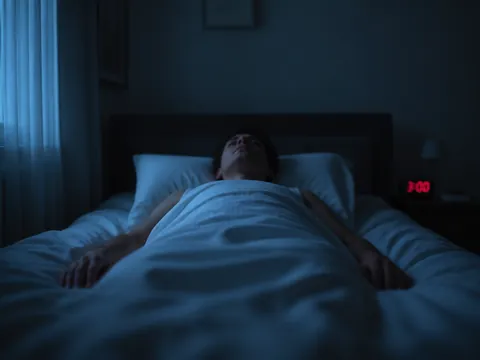
Insomnia is usually treated as the problem itself. You can't fall asleep, you wake at 3 a.m., you lie there doing arithmetic on how many hours are left — so the target is sleep, and the tools are sleep tools. Sleep hygiene. A wind-down routine. Maybe a prescription. For a large number of people that framing is correct and the tools work.
For a smaller group, it isn't, and they don't. The subject of PTSD and sleep sits in that gap: cases where the sleep complaint is not the disease but a symptom of something the person hasn't named, sometimes hasn't connected to sleep at all, and often doesn't have the vocabulary to describe. We want to walk through how to tell the difference, because the difference changes what helps.
We are not going to tell you that you have post-traumatic stress disorder. We can't, and a website shouldn't. We are going to lay out what distinguishes trauma-driven sleep disturbance from the more common kinds, what the research has actually measured, and what the answer changes downstream.
Can trauma cause insomnia?
Yes — and the more useful version of the question is whether it causes a particular kind of insomnia. Trauma exposure reliably disrupts sleep, and it does so through at least two routes that look different on a sleep study. The first is hyperarousal: an over-active stress-response system that keeps the body primed when it should be standing down. The second is the content of sleep itself, specifically nightmares and the fragmentation that comes with them. Ordinary stress can do the first for a while. The combination, persisting for months, is the pattern that points toward something trauma-related rather than a standalone sleep disorder.
That distinction matters because the treatments that work best for each are not the same. Treating a trauma-driven sleep problem as if it were garden-variety insomnia tends to produce partial, frustrating results — the kind that make people conclude that nothing works.
What the research actually measured
It helps to be precise about what is well-established and what is still contested, because the confidence in popular write-ups outruns the data more often than it should.
The hyperarousal model of insomnia — the idea that chronic insomnia involves a persistently elevated arousal system rather than a simple sleep deficit — comes largely from work associated with Michael Perlis, Michael Bonnet, and Donna Arand across the late 1990s and 2000s. They documented elevated metabolic rate, higher heart rate and a shifted balance of the autonomic nervous system toward sympathetic ("fight") activity in people with insomnia, both day and night. In trauma populations this baseline arousal tends to run higher still. The mechanism is plausible and well-supported: a system that won't disengage doesn't permit the descent into deep sleep.
Sleep architecture is where the evidence gets more interesting and more mixed. A frequently cited meta-analysis by Kobayashi and colleagues (2007, Journal of Clinical Sleep Medicine) pooled polysomnography studies of PTSD and found, broadly, more stage 1 (light) sleep, less slow-wave (deep) sleep, and more REM-related disturbance compared to people without the condition. The REM finding fits the clinical picture: REM is the stage most associated with vivid dreaming, and trauma-related nightmares cluster there, though not exclusively. But the effects were modest and varied a lot between studies, which is honest to report. The brain on trauma does not show up on a sleep study as a single clean signature. It shows up as a tilt — lighter, more broken, with REM that misbehaves.
Walking the mechanism forward
Consider the sequence as it actually unfolds across a night.
A person with a hyperaroused stress system goes to bed with sympathetic tone already elevated — heart rate a little high, cortisol rhythm flattened, the body interpreting "lying still in the dark" as a moment requiring vigilance rather than rest. Sleep onset is delayed because the down-shift into stage 1 and 2 requires the arousal system to release, and it won't. When sleep does come, the architecture skews light. Slow-wave sleep, which depends on sustained disengagement, gets shortchanged.
Then comes REM. In an unaffected sleeper, REM is where emotional memory gets processed and, in the prevailing theory, defused — the events of the day get filed without their full emotional charge. In trauma, this process appears to misfire. Instead of metabolizing the memory, REM replays it, often with the original physiological alarm attached. The person wakes — sweating, heart pounding, oriented toward threat. That awakening reinforces the very hyperarousal that started the cycle. The next night begins with the system already braced.
This is why a sleeping pill aimed only at sleep onset so often disappoints here. It can push someone past the first barrier without touching the engine running underneath.
Three things people confuse — and how to tell them apart
Most of the confusion around trauma and sleep comes from collapsing three distinct situations into one word, "insomnia." Lay them side by side against named criteria and the differences become legible. We'll use four: time course, the content of the bad nights, daytime intrusion, and how it responds to standard sleep treatment.

A. Acute post-stress insomnia
After a frightening, painful, or destabilizing event, sleep gets worse. This is expected and, in the strict sense, normal. The body's threat system is doing its job. On our four criteria:
- Time course: Days to a few weeks, then improving. It tracks the event and fades as the nervous system recalibrates.
- Content of bad nights: Worry, replay of the event, difficulty switching off — but typically without the recurrent, physiologically violent nightmares of a disorder.
- Daytime intrusion: Present but proportionate. The mind returns to the event; it does not hijack unrelated moments for months.
- Response to standard tools: Often good. Time, reassurance, and basic sleep stabilization usually suffice.
This is not a disease. Treating it as one risks medicalizing a normal recovery and, occasionally, interrupting it.
B. Chronic (primary) insomnia
Here the sleep problem has taken on a life of its own. It may have started with stress, an illness, a schedule disruption — but it persists past the trigger because conditioned arousal and unhelpful sleep behaviors have locked it in. The bed has become a cue for wakefulness. On the criteria:
- Time course: Three or more nights a week for three months or longer, by the DSM-5 threshold, often without a current external cause.
- Content of bad nights: Frustration, clock-watching, performance anxiety about sleep itself. The mind is busy about sleeping, not reliving an event.
- Daytime intrusion: Fatigue, irritability, concentration problems — the downstream costs of poor sleep, rather than re-experiencing of a specific memory.
- Response to standard tools: This is the signature. Chronic insomnia responds well to cognitive behavioral therapy for insomnia (CBT-I), the best-evidenced treatment we have for the condition.
C. Trauma-driven sleep disturbance
This is the pattern that the rest of this piece is about. It can coexist with a full PTSD diagnosis or sit somewhere short of one, and the sleep problem is frequently the part that surfaces first because it is the part people are willing to mention. On the criteria:
- Time course: Persistent, often for months or years, and tied — sometimes invisibly — to a past event rather than a current one. People often don't volunteer the connection, either because they don't see it or because they don't want to.
- Content of bad nights: Recurrent nightmares, frequently with replay-like or threat-themed content; abrupt awakenings with a startle or panic quality; a sense of needing to stay alert even in bed. The body acts as though the danger is current.
- Daytime intrusion: Beyond fatigue. Intrusive memories, heightened startle, avoidance, a baseline of being keyed-up — the same hyperarousal that wrecks the nights bleeding into the days.
- Response to standard tools: Partial. Sleep hygiene barely touches it. CBT-I helps but tends to leave residual symptoms, particularly the nightmares, untreated. This incomplete response is itself a clue.
Put plainly: if good sleep practices and even formal insomnia therapy produce real gains for the worry-and-clock-watching part of the night but the violent dreams and the wired-but-tired daytime keep going, that resistance is information. It suggests the sleep complaint is the surface of something the sleep tools weren't built to reach.
| Criterion | Acute post-stress | Chronic insomnia | Trauma-driven disturbance |
|---|---|---|---|
| Time course | Days–weeks, fading | 3+ months, self-sustaining | Months–years, tied to past event |
| Bad-night content | Worry, replay | Frustration about sleep | Recurrent nightmares, panic awakenings |
| Daytime | Proportionate distress | Fatigue, irritability | Intrusions, startle, hyperarousal |
| Responds to CBT-I / hygiene | Usually resolves on its own | Yes, strongly | Partial; nightmares often persist |
We've avoided stating a verdict at the top because the honest one only emerges from the comparison: the deciding features are not how bad the insomnia feels but its time course, its content, and crucially how it answers back to standard treatment. A person can have severe primary insomnia with no trauma involved at all. Another can have relatively mild-seeming sleep loss that is unmistakably trauma-shaped once you look at what the bad nights contain.
Why the distinction changes the treatment
If the problem is trauma-driven, two specific tools have evidence behind them that general sleep advice does not.
The first is prazosin, an alpha-1 adrenergic antagonist originally a blood-pressure drug, which dampens the noradrenaline signaling thought to drive trauma nightmares. The early trials, several led by Murray Raskind in the 2000s, were genuinely encouraging — small but positive, showing reduced nightmares and improved sleep in veterans. Then a larger, more rigorous study complicated the picture: Raskind and colleagues (2018, New England Journal of Medicine), a multi-site randomized controlled trial of 304 veterans, found prazosin no better than placebo on average for nightmares or sleep quality. That result deserves to be sat with rather than explained away. The current reading is that prazosin helps some people, perhaps those with higher adrenergic activity, but it is not the reliable fix the earlier work suggested. The data is thinner than the confidence with which prazosin is often prescribed.

The second is Imagery Rehearsal Therapy (IRT), a behavioral treatment in which a person rewrites a recurring nightmare while awake and mentally rehearses the new version. It sounds almost too simple to work. The evidence — including a frequently cited randomized trial by Barry Krakow and colleagues (2001, JAMA) in women with PTSD and chronic nightmares — found meaningful reductions in nightmare frequency and distress. Effect sizes in the nightmare literature are reasonably consistent, which is why IRT now anchors several clinical guidelines for nightmare disorder. It is one of the more durable findings in this space and, notably, requires no medication.
And then there is CBT-I itself, which we've called partial rather than useless, because that is what the evidence supports. CBT-I improves sleep in people with PTSD; it is worth doing. But studies tracking trauma populations generally find residual symptoms persist after a standard CBT-I course — the conditioned-insomnia component improves while the trauma-specific features, especially nightmares, lag. The pragmatic consequence is that these tools are often best combined rather than chosen between: insomnia therapy for the architecture and the conditioning, a nightmare-specific treatment for the content, and a clinician deciding whether a medication trial is worth it.
A brief verdict on the evidence as it stands:
- Hyperarousal as a mechanism of trauma-related sleep disruption — well-established.
- IRT for trauma nightmares — well-established, by the standards of this field.
- CBT-I improving but not fully resolving PTSD-related insomnia — well-established.
- Prazosin as a dependable nightmare treatment — plausible but thin, downgraded by the 2018 negative trial.
- The idea that you can fix any of this with sleep hygiene alone — folk wisdom, and not the helpful kind here.
The part nobody warns you about: disclosure
There is a practical barrier that sits between people and the treatments above, and it is rarely the treatments themselves. It is the fear of having to say what happened.
This fear is reasonable and worth taking seriously, so we'll be precise about it. To get help for trauma-related sleep problems, you do not have to narrate your trauma to a stranger on a first visit. You can describe what your nights are like — the nightmares, the awakenings, the wired feeling — without producing the event that caused them. A clinician trained in this work will not require disclosure as the price of admission. The diagnostic questions can be answered in terms of symptoms before they ever touch causes, and a good clinician knows the order matters.
This is not a small reassurance. A meaningful number of people with treatable trauma-related sleep disorders never seek care because they assume the conversation begins with the worst day of their life. It doesn't have to. It can begin with: I'm not sleeping, I'm having nightmares, and the usual advice hasn't worked. That sentence is enough to start.
There is also a quieter cost to leaving it untreated, and it's worth naming without inflating it. Chronic trauma-related sleep disruption tends to maintain the daytime condition rather than merely accompany it — the poor sleep feeds the hyperarousal that feeds the poor sleep. This is one of the few places where the loop is mechanistically clear, and it's part of why sleep is increasingly treated as a target in its own right within trauma care rather than an afterthought expected to resolve once "the real problem" is fixed. Sometimes the sleep is a real problem, and addressing it directly helps.
An honest rule of thumb
If your insomnia behaves like ordinary insomnia — worry, clock-watching, a problem about sleeping — start with the best-evidenced treatment for that, which is CBT-I, not a list of habits.
If your bad nights contain recurrent nightmares, abrupt panic awakenings, or a sense that your body is bracing for threat in the dark, and standard sleep approaches keep falling short, treat that resistance as a signal worth taking to a clinician — and describe the symptoms, not necessarily the cause. The pattern, not the severity, is what should route you.
One thing not to do: don't try to self-diagnose PTSD from a website, including this one. The point of distinguishing these three situations isn't to hand yourself a label. It's to recognize when the tools you've been reaching for were designed for a different problem.
What this looks like in practice
A note from one of our reviewers, a sleep clinician:
When someone comes in for insomnia, I no longer treat the first session as a sleep intake and stop there. I ask, fairly early, what the bad nights are actually made of — not the cause, just the texture. Worry has a texture. So does a nightmare that arrives with a pounding heart and a need to check the room. The two route to different places, and I've stopped assuming that the person watching the clock and the person bracing in the dark have walked in with the same complaint, just because they used the same word for it.
If your sleep problem keeps surviving the solutions built for sleep, the problem may not be your sleep.