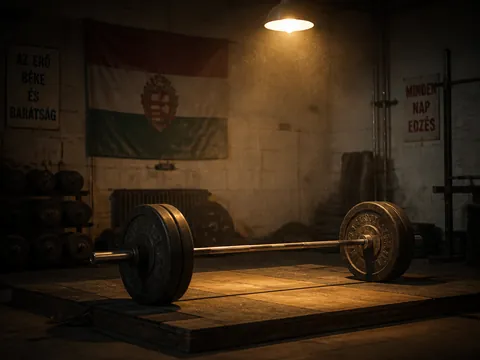
The story goes like this. In the 1970s and 80s, a Bulgarian weightlifting team the size of a mid-sized track club won an outrageous share of the available Olympic and world medals. Their coach, Ivan Abadjiev, had thrown out the periodized, volume-heavy orthodoxy of the era. His lifters trained to a daily maximum, in a handful of competition lifts, multiple times per day, nearly every day. The results spoke loudly. And ever since, the Bulgarian Method has carried the aura of a secret — high-frequency, near-maximal training as the real engine of strength, hidden in plain sight behind everyone else's three-sets-of-five.
That's the legend. We wanted to know how much of it survives contact with the evidence, and where the belief actually comes from.
What is the Bulgarian Method?
The Bulgarian Method is a high-frequency strength approach in which an athlete works up to a daily maximum — the heaviest weight that moves well that day — in a small number of exercises, performed most days of the week and often multiple times per day. There is little to no traditional volume accumulation, almost no exercise variety, and no planned light "deload" weeks in the classic version. The premise is specificity taken to its limit: to get strong in a lift, do that lift, heavy, constantly, and let the body adapt to the demand or wash out trying.
Modern barbell adaptations — the versions most lifters actually run — soften this considerably. Greg Nuckols and others have written about scaled "Bulgarian-style" templates that keep the daily-max idea but add accessory work and built-in autoregulation. The hard version and the practical version are not the same animal, and that distinction matters more than it usually gets credit for.
Where the belief came from
Trace the conviction back and it terminates almost entirely in one place: Abadjiev's results, and the stories told about his gym.
The numbers were real and they were stunning. Across the 1972–1996 span, Bulgaria — a country of roughly nine million — repeatedly out-medaled nations many times its size in Olympic weightlifting. Lifters like Naim Süleymanoğlu (who later competed for Turkey) and Yoto Yotov became the case studies. Abadjiev's training hall in Sofia became something close to mythology: athletes maxing morning and afternoon, training sessions measured in repeated singles, a coach who reportedly believed that adaptation to maximal stress was the only stimulus worth chasing.
This is the source of the belief. And here is the uncomfortable part: it is mostly anecdote. There is no published controlled trial of Abadjiev's system. What we have is an outcome — a great team — and a training description attached to it after the fact.
Why the source is thinner than the belief
Three confounds sit between "Bulgaria won" and "the method works."
The first is selection. Abadjiev's program was famously a furnace. By multiple accounts, lifters who couldn't tolerate daily maximal loading were cut, injured out, or never made the team. A system that survives only its survivors will always look effective from the outside. We never see the denominator — the lifters who broke down — because they don't show up at the Olympics.
The second is pharmacology. Bulgarian weightlifting of that era was not pharmacologically clean, and several positive tests and program collapses — including a mass withdrawal at the 2000 Sydney Games after pre-competition positives — make this hard to wave away. Anabolic support changes the recovery math fundamentally. Training that is sustainable on heavy androgen use is not necessarily sustainable without it, which is precisely the question a natural intermediate lifter is asking.

The third is survivorship at the cultural level. We remember Abadjiev because he won. Dozens of national programs ran idiosyncratic systems and produced nobody memorable; we don't cite them as evidence of anything. Attributing the outcome to the one variable that was loudest in the story is the classic post-hoc move.
None of this means the method doesn't work. It means the famous evidence for it is an existence proof, not a controlled comparison. The belief has a source. The source is thinner than the belief.
What high-frequency training plausibly does, step by step
Strip away the mythology and there is a real mechanistic case, worth walking through in the order it unfolds.
First, skill. The competition lifts — and to a lesser degree the squat and bench — are motor skills, and motor skills improve with practice frequency. Lifting near-maximal weights often means you rehearse the heavy-weight motor pattern more often, which sharpens technique and rate of force development under real load.
Second, specificity of adaptation. The principle is well-supported: adaptations are biased toward the exact stimulus trained. Train heavy singles and you get better at heavy singles, partly through neural drive and intramuscular coordination rather than muscle size.
Third — and this is where the hard version strains — fatigue management. Near-maximal work daily generates fatigue faster than it generates fitness for most people. The daily-max design partly self-regulates this: on a bad day, your "max" is lower, so you auto-deload. But that mechanism only protects you if the rest of the system isn't already over the line.
What the frequency research actually says
The honest answer is narrower than the legend. The well-established finding, from meta-analyses such as Schoenfeld and colleagues (2016, Sports Medicine), is that when total weekly volume is equated, higher training frequency offers little to no additional hypertrophy benefit. Frequency is a way to distribute volume, not a magic stimulus on its own.
For strength specifically, the case for higher frequency is slightly better. Some work — including reviews by Grgic and colleagues — suggests strength gains may favor higher frequencies modestly, plausibly through the skill and neural mechanisms above. But the effects are small, the studies are short, and almost none of them tested anything resembling true daily-max work in trained athletes. The data on the actual Bulgarian protocol, as opposed to "lift more often," is close to nonexistent.
An honest way to use the idea
| Approach | Best supported for | Main risk |
|---|---|---|
| Classic daily-max, no accessories | Drug-assisted, full-time, genetically selected lifters | Injury, burnout, no off-ramp |
| Scaled high-frequency (3–6x/week, autoregulated) | Intermediate lifters stuck at 1–2x/week | Underrecovery if volume isn't reined in |
| Standard 2x/week with progressive overload | Almost everyone, as a default | Slower skill acquisition |
If you're plateaued at low frequency, the defensible experiment is to raise frequency on your stuck lift to three or four sessions a week while cutting per-session volume so weekly volume stays roughly constant — and to autoregulate the top set by feel rather than chasing a true max daily.
Verdict. That high-frequency, near-maximal practice improves strength skill is plausible and modestly supported. That the classic Bulgarian Method is uniquely effective for natural, time-limited lifters is folk wisdom resting on an uncontrolled existence proof.
Train your stuck lift more often this week, but lighten each session so your weekly workload barely changes — frequency is a way to spread the work, not a license to add it.