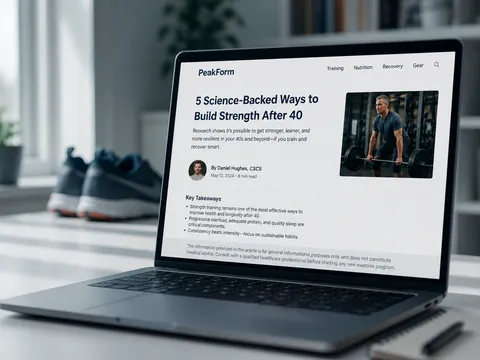
"Consult your physician before beginning any exercise program." You have read it a thousand times — at the bottom of a training article, under a video, beside a downloadable program. Most readers treat it as a force field: the site said it, so the site is covered, and the reader is on their own. That belief is widespread, and it is mostly wrong. A legal disclaimer does real work, but not the work it is usually credited with. It is a defense, not a shield, and the difference matters to anyone who publishes training content or follows it.
We went looking for where the confidence came from, because the confidence is much sturdier than the law underneath it.
Does a disclaimer protect the site or the reader?
In plain terms: a disclaimer mostly protects the publisher, and only partially. It does not transfer all risk to the reader, it does not make a lawsuit impossible, and it does not cover everything the publisher might do wrong. What it does is establish two things — that the content is informational rather than individualized medical advice, and that the reader was warned that exercise carries inherent risk. Those are useful facts in a courtroom. They are not a trapdoor that makes liability disappear.
The reader, meanwhile, is protected by the disclaimer almost not at all. The protective language runs one direction.
A short history of the boilerplate
The "consult your physician" sentence did not come from medicine. It came from liability law, and it arrived later than people assume.
For most of the twentieth century, the governing idea in American injury law was caveat emptor — let the buyer beware. If you bought a barbell or a mail-order fitness course and hurt yourself, the law generally assumed you accepted the risk. That changed in the 1960s. The landmark is usually cited as Greenman v. Yuba Power Products (California, 1963), where the state supreme court held that a manufacturer could be strictly liable for a defective product regardless of contract language. Section 402A of the Restatement (Second) of Torts, published in 1965, generalized the principle. Liability stopped being something you could simply disclaim your way out of.
Publishers and product makers responded the way risk-averse institutions always do — with language. Warning labels multiplied through the 1970s and 1980s. The fitness industry, growing fast and selling instruction to strangers it would never examine, adopted the medical-clearance sentence as standard furniture. By the time home video and then the open web arrived, the boilerplate was simply assumed. Nobody re-derived it. It propagated by copy-paste.
And here is the gap. The sentence was built for a world of physical products and face-to-face instruction. Courts had decades of doctrine for defective table saws. They had far less for "a stranger read my article and squatted badly." The belief that the disclaimer fully covers an information publisher was inherited, not tested. The source is thinner than the faith placed in it.
What actually happens when someone gets hurt
Run the sequence in order, because each step is a gate the claim has to pass through.
First, duty. A plaintiff must show the publisher owed them a duty of care. For general published information — an article, a free program — courts have been reluctant to find that publishers owe individual readers a medical-grade duty. This is the publisher's strongest ground, and it exists with or without a disclaimer.
Second, breach. Did the publisher fall below a reasonable standard? Publishing accurate, non-defective information is usually not a breach. Publishing something reckless might be.
Third, causation. The reader must show the content actually caused the injury, not their own modification of it, not a preexisting condition, not bad luck under the bar. Causation is where most informal-injury claims quietly die.
Fourth, assumption of risk. This is the doctrine the disclaimer feeds. By warning that exercise is inherently risky, the publisher strengthens the argument that the reader knowingly accepted ordinary risk. The disclaimer is evidence for this step. It is not the whole case.
Notice what the disclaimer touches: mainly step four, partly step one. It does nothing for a publisher who was genuinely reckless.
Content ownership, which is the part readers underestimate
Liability is half the story. The other half is intellectual property, and here the lines are clearer than people expect.
When a platform publishes original articles, programs, charts, and videos, that material is the platform's copyrighted work, typically from the moment it is fixed in tangible form. A reader may use it, learn from it, and apply it in their own training. A reader may not republish it, sell it, or pass it off as their own. That is true whether or not a terms-of-service page restates it, though restating it removes ambiguity.
What the reader owns is their own contributions — a forum post, a comment, a coaching note they wrote. Many platforms ask users to grant a license to display that contribution, which is not the same as taking ownership. A license lets the platform show your post; it does not make your words theirs. The distinction gets blurred constantly, usually in the platform's favor, and it is worth reading the actual clause rather than assuming the worst or the best.
Where the confidence outruns the evidence
Three things are commonly overstated.
Disclaimers do not bar claims of gross negligence or willful harm in most jurisdictions — courts routinely refuse to enforce a waiver of liability for reckless conduct. Enforceability varies by state and country, so a single sentence cannot be "bulletproof" across borders. And "informational, not medical advice" is a defense a publisher raises, not a wall that stops the case from being filed.
| The belief | What's actually true |
|---|---|
| A disclaimer transfers all risk to the reader | It mainly supports an assumption-of-risk argument |
| It makes lawsuits impossible | It makes some lawsuits weaker |
| It covers everything the publisher does | It does not cover gross negligence |
| The reader is protected too | The protection runs toward the publisher |
| The same language works everywhere | Enforceability is jurisdiction-dependent |
An honest rule of thumb: read the disclaimer to learn what the publisher is claiming, not what is guaranteed — and read the IP and licensing clauses more carefully than the liability ones, because those are the parts that actually bind you.
Verdict. That a disclaimer fully insulates a publisher: folk wisdom. That it strengthens an assumption-of-risk defense: well-established. That it settles content ownership cleanly: plausible but dependent on the exact license language.
A note on our own practice: we keep our masthead disclaimer to two sentences, and we spend the saved effort fact-checking the articles instead — on the theory that accurate writing is a better defense than defensive writing, and a far better thing to read.