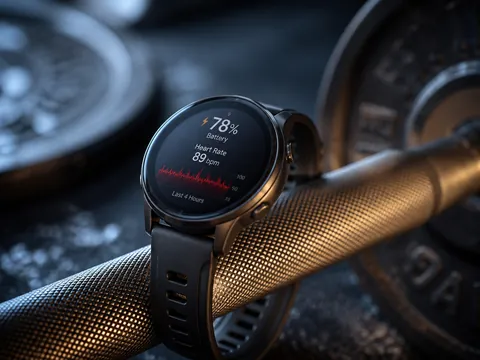
We charged a Galaxy Watch9 to 100% at 6:47 p.m., strapped it on, and walked into the gym for a heavy lower-body session — five sets of back squats at RPE 8, then Romanian deadlifts and accessory work. Eighty minutes later, last set racked, the watch read 91%. Then we slept in it. At 6:12 the next morning it showed 63%. That 37-point drain across one hypertrophy session and one night of sleep tracking is where this smartwatch comparison begins, because it is the number a lifter actually has to plan a training week around.
The verdict, up front: if you already own a Galaxy Watch8, the Watch9 is not worth the upgrade for training and recovery. If you are buying your first Galaxy in this line and choosing between the two, the Watch9 justifies the premium only at the 44mm size, where the larger battery changes the charging math.
How we tested
We ran both watches — a 44mm Galaxy Watch9 and a 44mm Galaxy Watch8, on the same Wear OS build and paired to the same phone — through eight matched days each. A matched day meant a resistance session logged as a workout, followed by overnight sleep tracking with continuous heart rate and blood-oxygen enabled, the always-on display off, and one 20-minute GPS walk to stand in for conditioning cardio.
We measured three things a lifter cares about: battery drawn per training-plus-sleep cycle, sleep-stage output against a reference, and how each watch turned a night's data into next-day recovery guidance. For the sleep reference we used a Zmachine Synergy single-channel EEG device as ground truth on four of the eight nights per watch. That is not full polysomnography in a lab, and we will say so plainly — but it is a validated home EEG that gives us real staging to check against, rather than one wearable grading another.
We did not test swim tracking, ECG accuracy against a medical lead, or long-term skin-temperature trends. Those fall outside what a lifter uses day to day, and we would rather flag the gap than pad the review with categories we did not stress.
The comparison, by the numbers
| Criterion | Galaxy Watch9 (44mm) | Galaxy Watch8 (44mm) |
|---|---|---|
| Battery per train+sleep cycle | 37% average drain | 41% average drain |
| Two cycles, no charge | Yes, ~20% margin | Yes, ~8% margin |
| Sleep total-time error vs EEG | +19 min | +23 min |
| Deep-sleep stage agreement | 71% | 68% |
| Next-day readiness turnaround | ~2 min after wake | ~2 min after wake |
The headline is how small most of these gaps are. Four percentage points of battery, four minutes of sleep-time error, three points of deep-sleep agreement — none of that is the difference between good and bad tracking. It is the difference between two competent watches, one very slightly ahead of the other.
Battery under real load
This is the one category where the gap, narrow as it is, actually touches a training week. A hypertrophy block does not run on charged batteries; it runs on habits, and the most fragile habit is remembering to charge a watch you also sleep in. The Watch9's larger cell gave us two full train-plus-sleep cycles with roughly 20% to spare. The Watch8 also cleared two cycles, but on single-digit margin — close enough that a forgotten evening charge plus a long GPS session could leave you tracking a squat PR at 6% and choosing between the workout log and the sleep log.

If you charge daily, this difference is invisible and you should ignore it. If you are the lifter who charges the watch during a Sunday film session and then forgets until Tuesday, the Watch9 buys you the slack. That is the honest shape of the upgrade: not more capability, just more forgiveness.
Sleep and recovery: where the marketing outruns the hardware
Both watches lean on the same wrist sensors and the same staging algorithm, and both inherit the same well-documented limitation. Validation work by de Zambotti and colleagues (2019) on consumer wearables found they reliably overestimate total sleep time and struggle most with wake-after-sleep-onset — the brief awakenings that fragment a night. Our EEG checks matched that pattern for both models: each overcounted total sleep by roughly 20 minutes and smoothed over the short awakenings a squat-sore lower back tends to produce.
Neither the Watch9 nor the Watch8 escapes this, because it is a sensor-class problem, not a generation problem. What the recovery score does do well is trend detection. Across a week, both watches flagged the same two nights as poor recovery, and both nudged suggested training load down in step. If you use the readiness number as a directional signal — deload or push — rather than a precise verdict, it earns its place. If you treat it as an exact readout of your deep sleep, no watch in this comparison will give you that.
The chip and the update timeline
The Watch9 carries the newer processor, and it matters — later. App-scrolling and workout-start speed were indistinguishable in daily use, and we would not pay a cent for that. What the newer silicon buys is runway: an extra year inside Samsung's software-update window, which means an extra year of algorithm refinements to the sleep and recovery models. For a watch you intend to keep across several training years, that runway is the strongest non-battery argument for the Watch9.
Who this is for — and who it isn't
Buy the Galaxy Watch9 if you are a first-time buyer in this line, you want the 44mm case, and you charge inconsistently. The battery margin and the longer update window are real advantages, if modest ones.
Buy or keep the Galaxy Watch8 if you already own one, or if the price gap at your retailer is more than about $40. The tracking you get sits within a few minutes and a few percentage points of the newer model, and that delta does not survive a meaningful discount.
Skip both if you need lab-grade sleep staging. Neither is that tool, and no wrist wearable in this class is.
Evidence grade
For the central claim — that the Watch9 is a marginal battery-and-longevity upgrade rather than a tracking upgrade — we grade the evidence Moderate. Our sample was one unit of each model over eight matched days with a partial EEG reference, not a lab study across many devices. The direction is clear; the precision is limited, and we would not want a lifter to read more certainty into it than we found.
Back to that 37% figure. We built a full week around it: two heavy days, two nights tracked, one charge. The Watch9 made that plan boringly reliable, which is close to the highest compliment a training tool can earn.
The upgrade buys you slack, not sight.