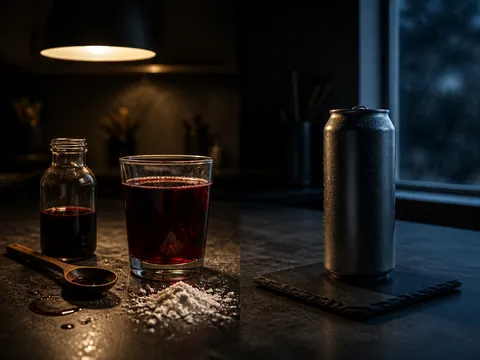
The advice arrives with the confidence of common sense: it's chamomile tea in a can, so make it at home and keep the five dollars. That verdict gets applied to nearly all of the new premium sleep aids — the tart cherry mocktails, the magnesium sachets in matte packaging, the reishi lattes, the canned moon milk that is turmeric warm milk with a brand identity. Mostly the verdict is right. We went through the underlying trials and the ingredient panels, and the rule survives contact with the evidence better than the marketing does. But it breaks in three specific places, and none of them is the place the advertising points at.
The category's current avatar is the sleepy girl mocktail: tart cherry juice, a scoop of magnesium powder, sparkling water. It spread through social feeds in 2023, and within about a year the same three-ingredient formula was available pre-mixed, chilled, and priced at several times its ingredient cost. That gap — between the folk version and the retail version — is the entire argument, and it has been running for as long as people have been selling other people's grandmothers' recipes back to them.
Do premium sleep drinks actually work?
For a healthy adult with ordinary sleep: modestly, sometimes, and mostly not through the mechanism printed on the front of the can. The best-supported ingredients in this category produce effects on the order of 10 to 25 minutes of additional sleep or reduced time awake, measured in trials that usually enroll fewer than 50 people. That is a real effect and a small one. It is also close to the size of effect a consistent pre-bed routine generates on its own, which makes the two nearly impossible to separate in a product you drink at the same time every night.
What the research actually measured
Tart cherry anchors the category, so it earns the most scrutiny.
Howatson and colleagues (2012, European Journal of Nutrition) gave 20 healthy adults 30 mL of Montmorency cherry concentrate twice daily for seven days in a crossover design. Actigraphy showed total sleep time up by roughly 25 minutes and sleep efficiency up by about 5 to 6 percent, alongside a rise in urinary melatonin metabolites. Pigeon and colleagues (2010, Journal of Medicinal Food) tested 8 oz of tart cherry juice twice daily in 15 older adults with insomnia: wake time after sleep onset fell by about 17 minutes against placebo, while time to fall asleep barely moved. Losso and colleagues (2018, American Journal of Therapeutics) reported roughly 84 additional minutes of sleep — in eight people. At n=8, that is a hypothesis with a press release attached.
The cherry mechanism, in the order it happens
The intuitive story is that cherries contain melatonin and you are drinking melatonin. That story is almost certainly wrong on dose. Montmorency cherries carry melatonin in the range of nanograms per gram; a serving of concentrate delivers something in the microgram neighborhood, against the 0.3 to 5 mg used in melatonin trials. Three orders of magnitude is not a rounding error.
The more defensible sequence runs like this. Procyanidin B-2, concentrated in the cherry skin, inhibits indoleamine 2,3-dioxygenase. That enzyme is what diverts dietary tryptophan down the kynurenine pathway. Inhibit it and more tryptophan stays available for conversion to serotonin, and from serotonin to melatonin, made by your own pineal gland on your own schedule. Losso's team measured exactly this — urinary tryptophan up, kynurenine down — which is the right way to test a mechanism, in a sample too small to settle it.
So: plausible, coherent, and thin.
The rest of the panel sorts out roughly as follows.
| Ingredient | Dose that showed an effect | Typical dose in a bedtime drink | Where the evidence stands |
|---|---|---|---|
| Tart cherry concentrate | 30 mL twice daily (Howatson 2012) | 15–30 mL total, often less | Plausible but thin |
| Magnesium | 500 mg oxide, 8 weeks (Abbasi 2012, n=46) | 50–200 mg glycinate or citrate | Plausible but thin |
| L-theanine | 200 mg/day, 4 weeks (Hidese 2019, n=30) | 100–200 mg | Plausible; dose usually in range |
| Chamomile | 270 mg extract twice daily (Zick 2011) — null result | One tea bag, highly variable | Folk wisdom |
| Valerian | 300–600 mg standardized extract | Trace to ~100 mg | Thin; poor trial quality |
| Ashwagandha | ~600 mg/day, 8+ weeks (Cheah 2021) | 50–150 mg | Plausible but thin at label doses |
Two entries deserve a note. The magnesium literature is repeatedly summarized as settled and is not: Mah and Pitre's 2021 systematic review in BMC Complementary Medicine and Therapies found three eligible randomized trials covering 151 participants total and rated the evidence low quality. And chamomile — the ingredient with the deepest folk pedigree in the whole category — is the one with a clean negative trial. Zick and colleagues (2011, BMC Complementary and Alternative Medicine) gave 34 adults with chronic insomnia 270 mg of standardized extract twice daily for 28 days and found no significant improvement in sleep latency or total sleep time. Apigenin does bind the benzodiazepine site on GABA-A receptors in vitro. That has not translated into a mug.
Where "just make it yourself" is right
Most of the time, the dose is the whole product, and the dose is reproducible. A 32 oz bottle of Montmorency concentrate yields more than thirty 30 mL servings; the per-serving cost lands well under a dollar. Magnesium glycinate in bulk powder is cheaper still. If the panel on a $5 can lists 15 mL of cherry concentrate and 100 mg of magnesium, the arithmetic is not close, and no amount of typography changes it.
This is the honest core of the skeptical advice, and it applies to the whole rebranding wave. Golden milk is turmeric and warm milk. Moon milk is golden milk with ashwagandha. The ingredients did not change when the packaging did.
Where the rule breaks down
Form and standardization sometimes aren't reproducible at home. Magnesium oxide — the form used in the most-cited trial — is poorly absorbed, on the order of a few percent, which is part of why that trial is hard to interpret. Glycinate and citrate absorb better, and glycinate additionally delivers glycine, which has its own small polysomnography literature (Yamadera 2007, Sleep and Biological Rhythms, roughly a dozen participants given 3 g before bed, with shortened sleep onset). A standardized valerian or ashwagandha extract is a manufacturing output, not a kitchen one. Loose herb steeped in water is a different substance from a quantified extract, and the trials were run on the latter.
Label accuracy runs in both directions. Cohen and colleagues (2023, JAMA, research letter) analyzed 25 melatonin gummy products and found actual content ranging from none at all to 347 percent of label. Erland and Saxena (2017, Journal of Clinical Sleep Medicine) tested 31 supplements and found a range from 83 percent below to 478 percent above label. Third-party testing and batch certificates are a real cost, and occasionally the premium is buying one.
The ritual is an active ingredient, and it isn't free. Stimulus control — reserving a consistent cue set for sleep — is one of the components of CBT-I with genuinely good evidence behind it, better evidence than anything in the ingredient table above. A drink at a fixed time is a competent conditioned cue. What it is not is thermoregulation: the passive body heating literature that people invoke for warm drinks (Haghayegh and colleagues, 2019, Sleep Medicine Reviews, pooling 17 studies) used baths of 40–42.5°C, one to two hours before bed, and found sleep onset latency cut by around a third. A 250 mL mug moves your core temperature by an amount too small to measure.1
A rule of thumb
Four checks, in order:
- Compare the panel dose to the trial dose. If it's off by more than roughly a factor of two, you are buying flavor and a cue.
- Treat "proprietary blend" without per-ingredient milligrams as an unpriced claim, and price it at zero.
- Pay the premium for third-party batch testing when the ingredient is one that gets mislabeled — melatonin above all.
- If you want the ritual, buy it deliberately, and buy it at the price of a ritual rather than the price of a drug.
The myth is that these are ancient remedies finally validated by modern science and poured into a can. The more accurate version is that they are ancient remedies at modern prices, usually underdosed against the very trials they cite, selling a nightly cue your nervous system would have accepted just as readily from a mug.
-
One cost the category rarely mentions: 250–350 mL of fluid within an hour of lights-out meaningfully raises the odds of a bathroom awakening for anyone with even mild nocturia. A drink that adds 20 minutes of sleep and subtracts one full awakening cycle has not obviously come out ahead. ↩