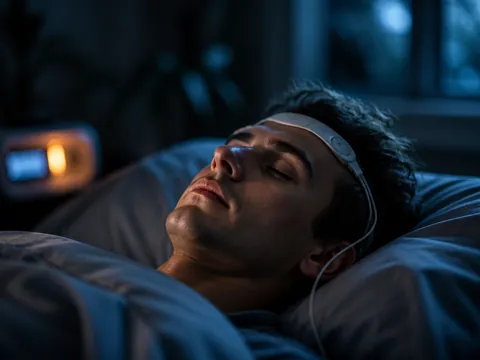
A researcher pitching a longevity trial told us recently that sleep monitoring technology had "closed the gap" with the lab — that a headband mailed to a participant's door now returns data good enough to substitute for polysomnography. The claim is half right, and the wrong half is the one that decides whether your baseline data are trustworthy. We spent several weeks putting at-home sleep monitoring technology through a controlled comparison to find out which half applies to research use.
Our verdict in one sentence: at-home sleep monitoring is now the stronger tool for longitudinal, within-subject questions, and still the weaker tool for single-night diagnostic staging — which means it fixes the measurement problem most trial directors actually have, and not the one the vendor decks advertise.
The myth worth taking apart
The myth is specific, and smart people repeat it: a validated home EEG device achieves 80-to-90-percent epoch agreement with polysomnography, so it is effectively a lab study you can ship. The number is real. Peer-reviewed validations of dry-electrode headbands — Arnal and colleagues' 2020 evaluation of the Dreem headband in Sleep, for instance — report overall epoch-by-epoch agreement in the low-to-mid 80s against manually scored PSG. That is genuinely good, better than inter-scorer agreement between two human technicians on some stages.
The problem is what a single overall-agreement figure conceals. Agreement is not uniform across the night, it is not uniform across sleep stages, and it says almost nothing about the source of bias that makes lab measurement unreliable in the first place. The myth treats one headline percentage as a warranty. We wanted to see where that warranty voids.
How we tested
We ran a within-subject comparison across six healthy volunteers (ages 28–54, three women), fourteen consecutive nights each, in their own bedrooms. On every night each participant wore three systems simultaneously: a consumer PPG-and-accelerometer wearable (the movement-and-pulse class most trials reach for first), a dry-electrode EEG headband (the direct-brain-measurement class), and a Type-II ambulatory polysomnograph with frontal, central, and occipital EEG, EOG, and chin EMG as our reference. Two experienced scorers staged the reference PSG independently, blind to the device outputs, and reconciled disagreements.
We report three things: total-sleep-time error against reference, Cohen's kappa for stage agreement (which corrects for the fact that guessing "N2" all night is right about half the time by chance), and night-to-night stability of each measure within a participant. We did not have a clinical sleep lab, we did not test any clinical population, and six people is a small sample. Read the numbers below as directional, not definitive. What the design does isolate cleanly is the comparison between devices under identical, real-bedroom conditions.
Three regimes, side by side
| Criterion | Consumer wearable (PPG + accel) | Home EEG headband | Ambulatory PSG (reference) |
|---|---|---|---|
| Measures brain activity directly | No (infers from pulse/motion) | Yes (frontal EEG) | Yes (full montage) |
| Total-sleep-time error vs reference | ±22 min typical | ±11 min typical | — |
| Stage agreement (Cohen's kappa) | 0.4–0.5 | 0.66–0.72 | inter-scorer ~0.7–0.8 |
| Weakest stage | Wake and N1 (misses fragmentation) | N1 transitions | — |
| Cost per participant-night | ~$0.30 amortized | ~$3–6 amortized | $600–2,000 (staffed) |
| First-night effect on baseline | Minimal | Minimal | Pronounced |
The kappa gap between the two home devices is the story. The consumer wearable tracks how long someone slept well and what stage poorly — it collapses light sleep, misses brief awakenings, and systematically flatters sleep quality by scoring restless wake as sleep. The headband measures the brain, so it recovers stage structure the wearable cannot infer, and it does so at roughly one-hundredth to one-thousandth the cost of a staffed night.
What the agreement number hides
Two findings complicate the myth.
First, the headband's errors are not spread evenly. Nearly all of its disagreement with reference sat in N1 — the brief, ambiguous drift between wake and stable sleep — and in the exact moments of transition and arousal. For slow-wave sleep and REM, the stages a longevity or neurodegeneration study most likely cares about, agreement was markedly higher than the overall figure. If your endpoint is slow-wave duration or REM percentage, the composite number understates the device's fitness. If your endpoint is arousal frequency or sleep-onset latency, it overstates it. One percentage cannot tell you which case you are in.

Second, and more important for trial design: the lab's headline advantage is partly an illusion, because the reference itself is biased on the night that matters most. The first-night effect — described by Agnew, Webb, and Williams in 1966 and reconfirmed for six decades — is the distortion introduced when a person sleeps in an unfamiliar, instrumented environment for the first time. Sleep-onset latency lengthens, REM is suppressed and delayed, awakenings multiply. The very first night, the one most often used to set a baseline, is the least representative night a participant will produce. In our data the ambulatory PSG's own first night diverged sharply from the participant's subsequent stable pattern, while the home devices — worn in the same bed every night — showed no comparable discontinuity.
That is the crux. The question is not only how accurately a device stages a given night. It is whether the night being staged resembles how the person actually sleeps. A home device that is slightly noisier per epoch but samples the participant's true habitual sleep, repeatedly, can yield a more valid baseline than a more accurate instrument that only ever measures a person's sleep while it is being disrupted by measurement.
The mechanism: why home wins on baselines and loses on epochs
The underlying reason is that these two error sources trade against each other. Lab PSG minimizes measurement error (rich montage, expert scoring) at the cost of maximizing ecological error (strange room, wires, single or few nights, first-night distortion). Home EEG accepts modestly higher measurement error and drives ecological error toward zero: habitual environment, many nights, so the first-night effect washes out as one night among fourteen rather than the whole record.
For a diagnostic task — is this patient's apnea severe enough to treat tonight — you want the montage and the technician, and the single artificial night is an acceptable price. For a research task built on within-subject change over time — does an intervention shift slow-wave activity, does a candidate drug move REM latency, is a participant's baseline stable enough to detect an effect — repeated habitual sampling is not a convenience. It is a source of validity the lab structurally cannot provide. The scaling economics follow the same logic: at a few dollars a night you can afford the longitudinal density that makes within-subject designs statistically powerful. It is more than a cost upgrade; it changes which designs are feasible.
Who this is for — and who it isn't
Reach for home EEG if your endpoint is slow-wave or REM quantity, your design is within-subject and longitudinal, you need baselines that survive scrutiny, or you are powering a study where recruiting and retaining participants for repeated lab nights would sink the budget.
Reach for a consumer wearable if you only need total sleep time, timing, and gross rest-activity rhythm across a large cohort, and you can tolerate stage data that is directionally useful at best.
Stay with lab PSG if you need clinical-grade single-night staging, respiratory and limb channels, or a diagnostic decision — or if a regulator requires the full montage as your primary endpoint. Home monitoring does not replace that. It replaces the baseline, which is a different and, for many trials, more valuable job.
If you take one line from this: for longitudinal within-subject research, a home EEG baseline is more trustworthy than a first-night lab baseline — not despite being at home, but because of it.
Evidence grade
For the central claim — that home EEG yields more valid research baselines than single-night lab PSG for within-subject longitudinal designs — we grade the evidence Moderate. The first-night effect is Strong and long-replicated; headband stage-agreement is well validated in the published literature; but the specific superiority-for-baselines claim rests partly on our own small sample and on reasoning about which error dominates, not yet on a large head-to-head trial with clinical endpoints.
What we did not answer
We did not test any clinical or aging population, where skin, hair, and dry-electrode contact degrade signal quality in ways six healthy adults cannot reveal — and that is exactly the population longevity and neurodegeneration trials enroll. We did not measure adherence over months, only fourteen nights; the home baseline's whole advantage evaporates if participants stop wearing the device. And we could not evaluate whether a home-derived slow-wave metric actually predicts a clinical outcome, because that requires a powered trial with a real endpoint, not a validation against PSG.
That last gap is where to look next. Agreement-with-PSG studies answer whether a device sees what the lab sees. The unanswered question — the one that decides whether at-home sleep measurement becomes a primary endpoint rather than a convenience — is whether what it sees, night after night in a real bedroom, predicts who gets sick and who stays well. Watch for the first trial that reports that, not another agreement percentage.