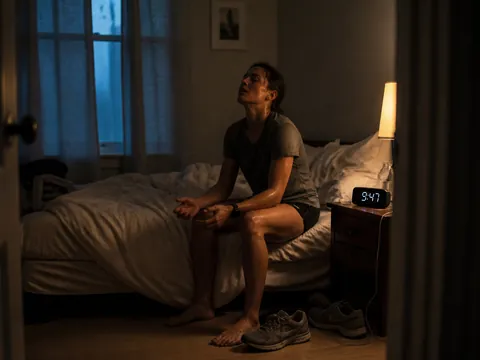
For two weeks this spring, one of us ran the same four-mile loop at two different times and wrote down what a wrist tracker said afterward. Same route, same shoes, pace within about ten seconds a mile. Seven nights the run finished at 6:40 p.m. Seven nights it finished at 9:15 p.m. — squarely inside the window that most advice about exercise timing and sleep says to avoid.
We tracked two numbers only: estimated minutes to fall asleep, and average overnight heart rate.
Minutes to fall asleep: 12 on early nights, 14 on late nights. That difference is noise. Average overnight heart rate: 54 bpm early, 59 bpm late. Every single late night was higher than every single early night, and the nightly heart-rate low point arrived roughly 90 minutes later. Subjectively, the late nights felt unremarkable — fall asleep fine, wake up fine, slightly flatter the next morning.
The caveats are large. One person, fourteen nights, unblinded, no polysomnography, and consumer devices estimate sleep onset from movement and heart rate rather than measuring it. We would not publish that as a finding. We bring it up because it lands almost exactly where the controlled literature lands, and because the mismatch inside it — sleep felt untouched, the cardiovascular system did not — is the whole story.
What the trials actually measured
The most useful pooled analysis we have is Stutz, Eiholzer, and Spengler (2019, Sports Medicine), which combined 23 studies of evening exercise in healthy participants, mostly crossover designs with lab sleep recording. Their overall answer was that evening exercise did not impair sleep. Slow-wave sleep rose slightly — on the order of a percentage point of total sleep time. REM fell by a comparable sliver.1 Time to fall asleep was, if anything, shorter.
One subgroup broke the pattern, and it broke it consistently: vigorous exercise ending less than about an hour before bed. There, time to fall asleep lengthened and sleep efficiency dropped.
Frimpong and colleagues (2021, Sleep Medicine Reviews) looked specifically at evening high-intensity exercise across 15 studies and reached a compatible conclusion. Hard evening sessions that ended roughly two hours or more before bed generally left sleep intact. The exceptions clustered around unaccustomed participants and very late finishes.
Worth naming the limits. These trials mostly recruited young, healthy, reasonably fit people who already slept well, then gave them one bout of exercise in a sleep lab. They tell us little about a 45-year-old with mild insomnia doing this four nights a week for a year.
Does exercising at night ruin your sleep?
For most healthy adults, no. Controlled trials find that moderate exercise finishing an hour or more before bed leaves sleep architecture essentially unchanged, and sometimes marginally better — slightly more deep sleep, slightly faster sleep onset. The reliable exception is vigorous effort ending within about an hour of lights out, which lengthens the time it takes to fall asleep and keeps heart rate elevated through the first part of the night. What matters is how hard the session was and how recently it ended, not the number on the clock.
The mechanism, in the order it happens
Minutes 0 to 45: everything goes up
Hard exercise raises core body temperature by roughly 1 to 2°C. Sympathetic outflow rises, epinephrine and norepinephrine spike, and above roughly 60 percent of VO2max, cortisol climbs above resting levels. Heart rate is obviously high. None of this is compatible with sleep onset, which is why the within-one-hour finding is the least surprising result in this literature.
Minutes 45 to 120: the fall, which is the useful part
Skin blood vessels dilate, you sweat, and heat leaves the body. Core temperature comes back down and typically undershoots where it started. A falling core temperature is one of the signals that permits sleep onset, and the cleanest demonstration is not from exercise at all — it is from bathing. Haghayegh and colleagues (2019, Sleep Medicine Reviews) pooled studies of passive body heating and found that a warm bath at roughly 40 to 42.5°C, taken one to two hours before bed, shortened sleep onset latency by about ten minutes. Heat the body, then let it dump heat, and sleep comes faster. Exercise does something structurally similar, with adrenaline attached.
Hours 2 to 4: autonomic recovery is the slow variable
This is where the self-experiment and the literature converge. Myllymäki and colleagues (2011, Journal of Sleep Research) had 11 healthy men perform vigorous cycling ending about two hours before bedtime. Sleep quality on polysomnography was not meaningfully disturbed. Nocturnal heart rate was elevated and heart-rate variability suppressed for hours. Eleven people is a small study. But the direction has held up in wearable data since, and it explains something that confuses self-trackers: your sleep stages can look normal while your recovery metrics look bad, because those two things are measuring different systems recovering on different timelines.
Overnight and the next day: a small circadian nudge
Youngstedt, Elliott, and Kripke (2019, Journal of Physiology) built a phase-response curve for exercise in 101 participants, giving an hour of moderate treadmill work at eight different times of day. Morning and early-afternoon exercise shifted circadian phase earlier. Exercise in the 7 p.m. to 10 p.m. range shifted it later. The magnitudes were modest — well under an hour. For someone who already drifts late, though, a nightly 9 p.m. session is a small push in the direction they are already going.
Where the reassuring story breaks down
The most underrated culprit in late-workout insomnia is not the workout. Drake and colleagues (2013, Journal of Clinical Sleep Medicine) gave 12 participants 400 mg of caffeine at 0, 3, or 6 hours before bed. Even the 6-hour dose cut objectively measured sleep by more than an hour. A heavily dosed pre-workout at 8 p.m. is a pharmacological intervention, not a training variable, and people routinely blame the treadmill for it.
Then the ordinary confounders: bright overhead gym lighting at 9 p.m.; competitive arousal and post-game rumination, which is why late team sports and races behave worse than solo sessions; and a large late meal.
Chronic load is a separate question. Fragmented sleep is often described as one of the earliest signs of functional overreaching in athletes, but that evidence is largely observational and confounded by travel and competition schedules. We would call the general claim plausible, the specific thresholds unsupported.
What to expect, by finish time and intensity
| Finish before lights out | Moderate (conversational, ~60–70% max HR) | Vigorous (intervals, heavy lifting, >80% max HR) |
|---|---|---|
| 3+ hours | No measurable cost; small deep-sleep gain | No measurable cost in trials |
| 1–3 hours | Fine for most; heart rate slightly higher early on | Usually fine for sleep stages; HR up and HRV down for 1–3 hours |
| Under 1 hour | Usually fine; keep the effort easy | The one condition trials flag consistently: slower sleep onset, lower efficiency |
An honest rule of thumb: if the 9 p.m. slot is the only slot, put the easy work anywhere and give the hard work a two-hour buffer before lights out. Move caffeine to before 2 p.m. And before concluding anything from your own data, collect at least ten nights per condition — Baron, Reid, and Zee (2013, Journal of Clinical Sleep Medicine) followed 11 women with insomnia and found that night-to-night exercise had no reliable effect on that night's sleep, while poor sleep clearly predicted less exercise the next day. The causal arrow, on a daily timescale, mostly runs the other way.
The verdict, stated plainly
Well-established: moderate evening exercise does not degrade sleep in healthy adults, and habitual exercise modestly improves it. Well-established but narrow: vigorous exercise ending within about an hour of bed slows sleep onset and keeps nocturnal heart rate up. Plausible but thin: the two-hour buffer as a precise number, and wearable recovery scores as a guide to whether a session was worth it. Folk wisdom: never exercise after dinner, or after 7 p.m., or at all in the evening.
Back to the loop
Our runner did not go back to 6:40 p.m. The 9:15 p.m. slot was the one that actually existed most days, and the sleep cost was not detectable. What changed was smaller: intervals moved to the afternoons they were available, the late runs stayed easy, and the pre-run coffee went away. Overnight heart rate came back down to 55.
Here is something to try this week. Take one hard session and end it two and a half hours before lights out. Write down two numbers that night and the three nights after: minutes to fall asleep, and your average overnight heart rate. Four nights of your own data will not settle the science, but it will tell you which of the two systems in this article is the one you actually need to manage.
The clock was never the variable. The last hour was.
-
A small REM reduction gets reported as harm more often than it should. Nobody has shown that a one-point shift in REM proportion on a single night carries any functional cost, and the same trials found sleep onset and efficiency unchanged or improved. ↩