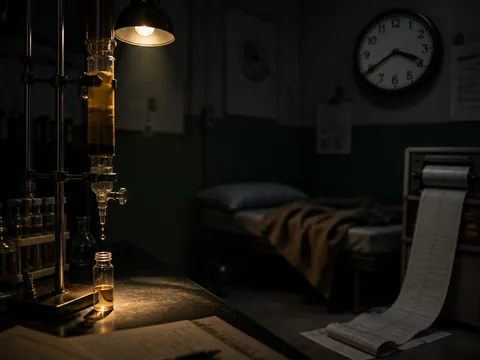
In 1982, a group of researchers finished a purification that had taken them the better part of a decade. They were chasing a substance that accumulated in sleep-deprived animals and, when injected into rested ones, put them into deep slow-wave sleep. They called it factor S. When they finally had enough of it to run the chemistry, the molecule turned out to be a muramyl peptide — a fragment of bacterial cell wall.
That finding is the taproot of a research line that now reaches all the way to fecal microbiota transplantation as an experimental treatment for chronic insomnia. We think the history is worth walking through, because the belief has grown considerably faster than the evidence underneath it.
The sleep factor that turned out to be bacterial
The common citation here is Krueger, Pappenheimer, and Karnovsky, 1982, in the Journal of Biological Chemistry. John Pappenheimer's lab at Harvard had spent years collecting cerebrospinal fluid from sleep-deprived goats and then, when that source proved too dilute, processing enormous volumes of human urine to yield micrograms of active material. Injected into rabbits, purified factor S increased slow-wave sleep in a dose-dependent way.
The chemistry was the surprise. Muramyl peptides are not made by mammals. They come from peptidoglycan — the structural mesh of bacterial cell walls. The most parsimonious reading was that fragments of gut bacteria were crossing into the host, circulating, and acting on sleep-regulatory circuits.
Here is the part that usually falls out of the retelling. Muramyl dipeptide is also pyrogenic. It induces fever, and it does so through the same interleukin-1 signaling that drives its effect on sleep. Krueger's later work made the case that IL-1 and TNF are genuine physiological sleep regulators, not merely sickness signals, and that case is reasonably strong. But the founding experiment could not cleanly separate "bacterial molecules promote sleep" from "bacterial molecules make animals sick, and sick animals sleep." Four decades on, that ambiguity has not been fully retired. It has mostly been forgotten.
What the germ-free and antibiotic-treated mice actually showed
The modern microbiome era gave the idea a second life, this time with sequencing. Ogawa and colleagues (2020, Scientific Reports) depleted the gut microbiota of mice with a four-week antibiotic cocktail and recorded EEG. The depleted animals did not simply sleep less. Their sleep was redistributed across the light-dark cycle, with altered REM and NREM proportions and changes in EEG power spectra. The sample was a few dozen animals, which is standard for the field and small for drawing conclusions about humans.
A more mechanistically satisfying result came from Szentirmai and colleagues (2019, Scientific Reports), who infused butyrate — a short-chain fatty acid produced when gut bacteria ferment dietary fiber — directly into the portal vein of mice. NREM sleep rose by roughly half over the following six hours. Oral tributyrin produced a similar effect. Systemic injection did not work as well, which points to something being sensed in the hepatoportal region rather than in the brain.
That is a real mechanism with a plausible address. It is also a study in mice, with the metabolite delivered by a route no human will ever use.
How the signal would have to travel
In the order it actually happens
Fiber that resists digestion in the small intestine arrives in the colon. Resident anaerobes ferment it, producing acetate, propionate, and butyrate within hours of a meal. Butyrate is largely consumed by colonocytes, but what remains enters the portal circulation and passes the liver. Vagal afferents in the hepatoportal region carry that chemical information to the nucleus tractus solitarius in the brainstem, which projects onward to hypothalamic regions that gate sleep and wake. In parallel, bacterial cell-wall fragments and lipopolysaccharide engage innate immune receptors, raising IL-1β and TNF, both of which promote NREM sleep when infused into the brain.
That is two plausible routes: a metabolite route and an immune route. Both are supported by animal work. Neither has been demonstrated end to end in a human being.
One commonly cited link does not survive scrutiny. Yano and colleagues (2015, Cell) showed that spore-forming gut bacteria drive serotonin production by enterochromaffin cells, and roughly 90 percent of the body's serotonin is in the gut. This gets repeated as though it explains sleep. Peripheral serotonin does not cross the blood-brain barrier. Whatever the gut is doing to the sleeping brain, it is almost certainly not doing it by shipping serotonin upstairs.
Can a fecal transplant cure insomnia?
No — not on the current evidence, and not outside a clinical trial. The strongest human result is a single small randomized, double-blind study reported in 2025, in which adults with chronic insomnia disorder received oral capsules containing roughly 200 billion microbes per dose. Objective sleep efficiency in the treatment arm rose from about 79.3 percent to 93.2 percent, and time awake after sleep onset fell by about 41.5 minutes. Those are large numbers by insomnia-trial standards.
Three things complicate them. First, the treatment group received antibiotics before transplantation and the control group did not, so the design cannot separate the effect of the donor microbes from the effect of clearing out the recipient's own. Second, both groups reported feeling better early on, which is the expected signature of a strong placebo response in a condition defined partly by subjective distress. Third — and this is the finding we keep returning to — shifts in microbiome diversity did not track the sleep improvements. If the transplanted community were doing the work, the dose-response relationship should be visible in the sequencing data. It was not.
We are not dismissing the trial. A 14-point gain in sleep efficiency measured objectively is not nothing, and the researchers named their own confound rather than burying it. But one trial with a structural asymmetry between arms is a reason to run the next study, not a reason to change practice.
What we would actually tell someone considering this
| Claim | Verdict |
|---|---|
| Bacterial molecules alter sleep architecture in animals | Well-established, replicated across labs since 1982 |
| Short-chain fatty acids signal to sleep circuits via the vagus | Plausible, mechanism located, rodent-only |
| Human microbiome composition correlates with sleep quality | Plausible but thin; small cross-sectional samples |
| Microbiota transfer improves objective sleep in insomnia | Plausible but thin; one confounded RCT |
| Probiotic supplements or yogurt treat insomnia | Folk wisdom |
The rule of thumb: if a clinic offers stool-derived capsules for sleep, it is selling ahead of the evidence. The defensible route today is enrollment in a registered trial, where the material is screened and the outcome is recorded.1
The question that decides this
Everything above is compatible with two opposite stories. In one, the gut community is upstream — its metabolites and cell-wall fragments set the tone of sleep circuits, and correcting the community corrects the sleep. In the other, the microbiome is downstream — fragmented sleep disrupts feeding times, cortisol rhythms, and gut motility, and the altered bacterial profile is a readout of insomnia rather than its engine. Transplantation would then be treating a shadow.
No human study has yet separated these, because doing so requires manipulating the microbiome without touching sleep, or manipulating sleep without touching the microbiome, and nobody has cleanly managed either. So the question stands, and it is the only one that matters: when we change someone's gut bacteria and their sleep improves, have we treated the cause, or merely edited the evidence?
-
Screening is not a formality. In 2019 the FDA issued a safety alert after two immunocompromised patients developed invasive infections with a drug-resistant organism transmitted by donor stool; one died. Transplanted microbial communities are living material, and living material carries what it carries. ↩